

Nervous System: Understanding & Regulating
What does it mean?
The nervous system has fascinated scientists and non-scientists for centuries, as it sits at the centre of how we perceive, react and adapt. Early research focused on understanding how nerves carry information between the brain and the rest of the body, and over time, how this regulation happens automatically and in constant response to our internal and environmental demands. This led to a deeper understanding of the autonomic nervous system (ANS) and its role in maintaining balance between activation, recovery and adaptation.
Of particular interest is the vagus nerve, the 10th cranial nerve and a major component of the ANS. It connects the brain with several major organs and is involved in the regulation of processes such as heart rate, digestion and breathing. Measures such as resting heart rate and heart rate variability (HRV) can offer useful insight into autonomic regulation and how the body is responding to demands, helping us understand readiness and well-being.
In particular, heart rate (HR) is the number of heartbeats per minute, whereas heart rate variability (HRV) reflects the variation in time between consecutive heartbeats. For example, if someone has a HR of 60bpm, it is unlikely that the heart beats are exactly one beat per second (60 seconds, 60 beats); instead, the distance between beats changes constantly changing, and will be something like 0.76s, 0.89s, 0.91s, 1.06s, etc., as represented in the picture below.
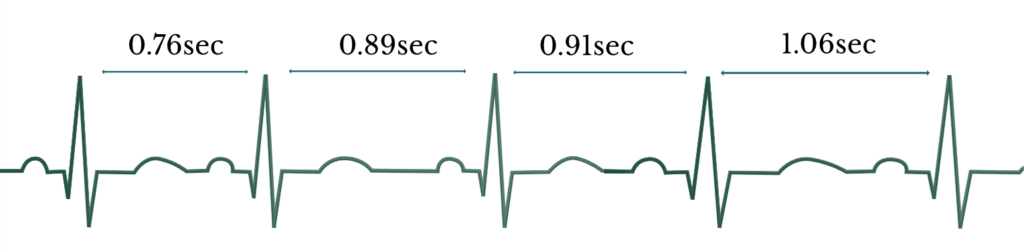
This variation results from the interaction between the cardiovascular system and the ANS, which consists of two main branches: the sympathetic (SNS) and the parasympathetic (PNS) branch. The SNS predominates in states of physical activity, stress or anxiety, while the PNS (largely mediated by the vagus nerve) predominates in states of relaxation. These two branches are in constant interaction, and in a way, HRV reflects the balance between these systems and acts as an indicator of how the body responds to stress—whether from training, work, caffeine, lack of sleep, or other life stressors.
Since the capacity to handle stress is limited, it can be useful to keep track of it. For athletes, strategies to control the amount of stress and recovery are key to facilitate the adaptation to training, ameliorate performance and prevent problems associated with overtraining. Measuring HRV, together with other lifestyle variables such as sleep metrics or recovery strategies, can help identify when the body is primed to train and when it would benefit from resting. Over longer periods, it can also help to determine whether a training plan is supporting progress or it may be leading to injury or burnout.
What I can help you with:
Understand what HRV is and how to interpret it
Reviewing and making sense of your data (HRV, sleep, training, subjective states, amongst others).
Discussing training load to support adaptation and recovery
Exploring lifestyle habits for long-term well-being
How can we work together?

1-to-1 Sessions
Tailored sessions to address your personal goals and challenges.
-
Tailored sessions to gain an understanding of HRV, explore your data, and create actionable recommendations.
HRV is used as an educational and reflective tool, not a score to chase or a judgement of readiness. The aim is understanding how your body responds to stress, recovery, training, and lifestyle.
A confidential, supportive space to explore and reflect. There is no judgement and no fixed agenda. I work alongside you as a mirror, helping you gain perspective and understand your patterns.
-
Session 1 is educational: gain a deep understanding on what HRV (and isn’t)
Session 2 is also educational: using heart rate, subjective variables for training, alongside scientifically proven techniques to modulate vagal activity
Optional access to a beta programme to track lifestyle factors
Data is explored together in sessions, not interpreted in isolation
-
What HRV represents physiologically
Relationship between HRV, stress, recovery, and lifestyle
Relationship between HRV, resting HR and subjective measures
Fluctuations in data
Using data to support decisions
-
Curious athletesand non-athletes
People feeling constantly ‘switched on’ or overstimulated
Individuals seeking understanding & are open to reflection
People with or without prior experience with devices
-
Clearer understanding of your body’s responses to stress and recovery
Identifying lifestyle factors that matter for you
Greater awareness of your body, habits and recovery
Less confusion around data
Clearer priorities around recovery and stress

Workshops
Educational and reflective workshops grounded in both science and real sporting experience. Available online or in person and tailored to teams, clubs, and corporate wellness.
-
Making physiological concepts understandable and usable in real-training contexts.
Typical themes include:
What HRV really represents (and what it doesn’t)
Stress, recovery, and lifestyle interactions
Applying HRV, resting HR and subjective variables for guiding training
-
A clearer understanding of physiological responses to stress and recovery
Reduced confusion and misinterpretation of HRV data
Practical perspectives they can apply immediately
Space for reflection, discussion, and questions
Normalisation of variability and day-to-day fluctuations
-
Online or in person
A combination of explanation with practical exercises
Adapted to sport, level, age group, and context
Typical duration: 60mins
*I also work with teams, clubs, and organisations in a more flexible, context-specific way. This usually involves a combination of education, individual support, and collaboration with staff over time. If you’re involved in a team or club and would like to discuss possibilities, you’re welcome to reach out.